
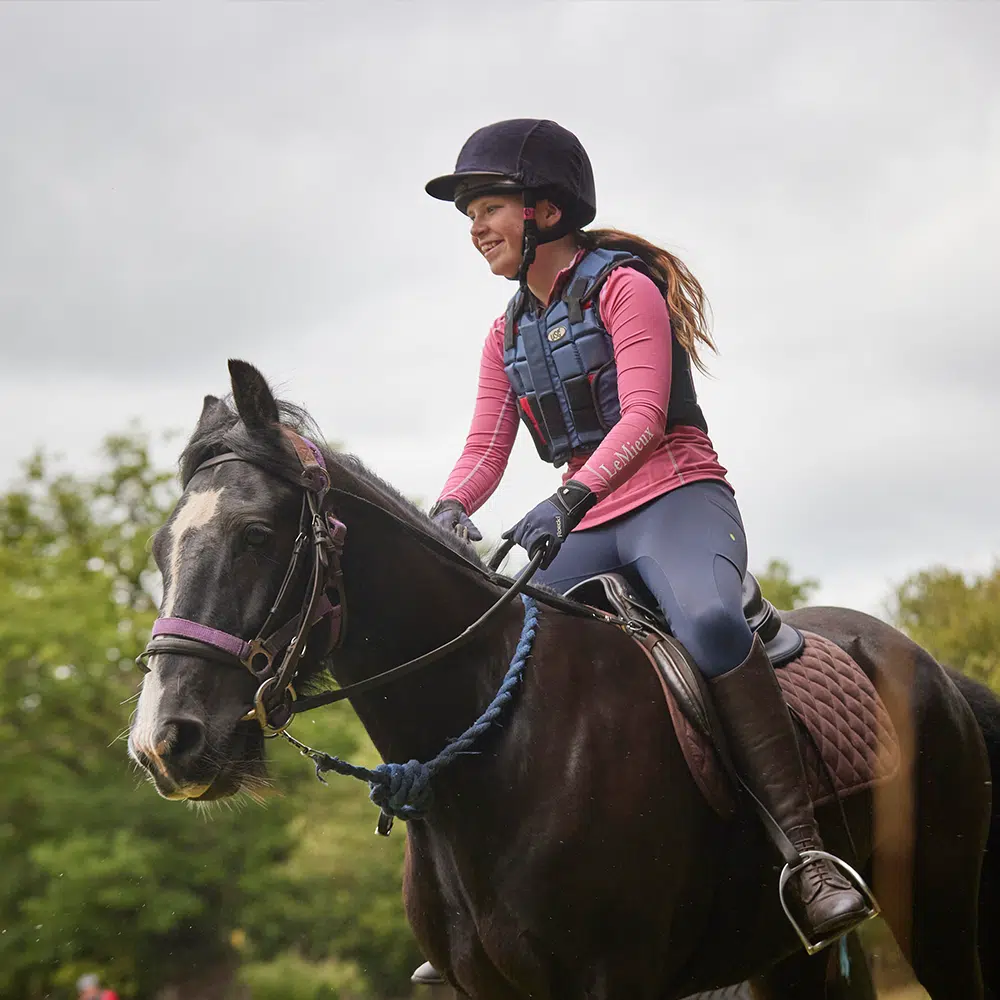
The core dressage moves are very much learnable, even for complete beginners. They build on each other, starting with the basics of stopping and going, and gradually developing into other skills as confidence grows. Here’s a look at the key moves young riders will encounter on their dressage journey.
The Halt
Before you can go anywhere, you need to know how to stop, and in dressage, the halt is its own move. A good halt isn’t just pulling on the reins. It’s about sitting tall, closing your legs gently against the horse’s sides, and softly squeezing the reins until the horse comes to a calm stop.
When done well, the horse stands with all four feet evenly placed. It sounds simple, but nailing it takes practice and teaches riders to think about the horse’s whole body.
The Walk
The walk is where everything begins. In dressage, there are actually different types of walk, which are medium, free, and collected. But for beginners, the focus is on a rhythmical, forward-moving walk with a relaxed rein contact. Riders learn to follow the natural swing of the horse’s back with their hips, rather than sitting rigidly. It feels a little like sitting on a very slow rocking chair.
The Rising Trot
The trot is when things start to feel a little bit more exciting. The rising trot is where riders rise out of their saddle in rhythm with the horse’s movement, and is one of the first key skills in dressage for beginners. It reduces the impact on the horse and rider and teaches people to find the rhythm of movement under them.
The Sitting Trot
Once a rider is comfortable with rising trot, the sitting trot comes next. Here, the rider stays in the saddle and absorbs the movement through a soft lower back. This type of trot needs core strength and relaxation at the same time, which can be tricky for beginners. But with regular riding, this improves super-fast and can be quickly developed.
The Canter
This is one most people have probably heard of, and often it’s young riders’ favourite pace as it’s smooth but powerful. In dressage terms, the canter should be balanced and “uphill” in feel, meaning the horse is light on its forehand. For beginners, the goal is simply to sit quietly, keep a steady rhythm, and learn to ask the horse to strike off into canter from trot using the outside leg. Once they get that first clean canter transition, it’s a real milestone moment!
Circles and Turns
Straight lines are the foundation, but dressage is also full of curves. Riding accurate circles (usually 20 metres in diameter for beginners) teaches riders all about balance, steering, and how to use their inside leg to bend the horse around corners. It might sound simple, but it’s never easy to get a horse to make a perfect circle at this early stage.
The Rein Back
One of the trickier basic dressage moves, the rein back asks the horse to walk backwards in a straight line. It requires hand and leg movement, with a good understanding of the horse’s response. For young riders, this move is a brilliant lesson in softness as it highlights how much can be achieved through a few light, clear directions, rather than force.
Transitions
These are the backbone of dressage. It involves moving smoothly from walk to trot, trot to canter, and back again. Your children are unlikely to be in competition at this stage, but eventually, this is what judges look for. They want to see prompt and smooth transitions that happen at the right time. For beginners, the aim is to make them feel balanced and not rushed or heavy.
Why Dressage is Great for Kids
Dressage moves might sound technical, but they’re genuinely fun to learn, and brilliant for young people. Here’s why some parents love it:
- It builds confidence: achieving even a basic move well gives children a real sense of accomplishment that goes beyond just horse riding.
- It teaches empathy: learning to communicate with an animal through kindness and clarity is one of the most powerful experiences a child can have.
- It improves focus and coordination: riding engages the brain and body, making it a fantastic activity for kids.
- It’s joyful to see: there’s just something so special about the bond between a child and a pony that’s just hard to put into words.
Ready to Trot Into Summer? Try a PGL Pony Camp
The best way to put these dressage moves into practice is in the saddle, and our specialist pony camps at PGL are built for exactly that. The Pony Beginner Camp (ages 8–13) is perfect for first-timers and early riders looking to build confidence and learn the fundamentals in a safe, supportive environment. Already found their stride? The Pony Improver Camp pushes things further, developing technique, rhythm, and that all-important connection between horse and rider.
Both camps combine horse riding with a full PGL residential experience, so your child gets to work on their walk-to-trot transitions and make some incredible memories. Get in touch with our team today if you have any questions, and we’ll be happy to help!